
Check out this breaking news report.
This article covers key details about Stealing Rain From Neighbors? Kazakhstan’s Cloud-Seeding Experiment Sparks Regional Fears.
Aggregated from leading news outlets, this report covers the ground reality.
See the complete story here.
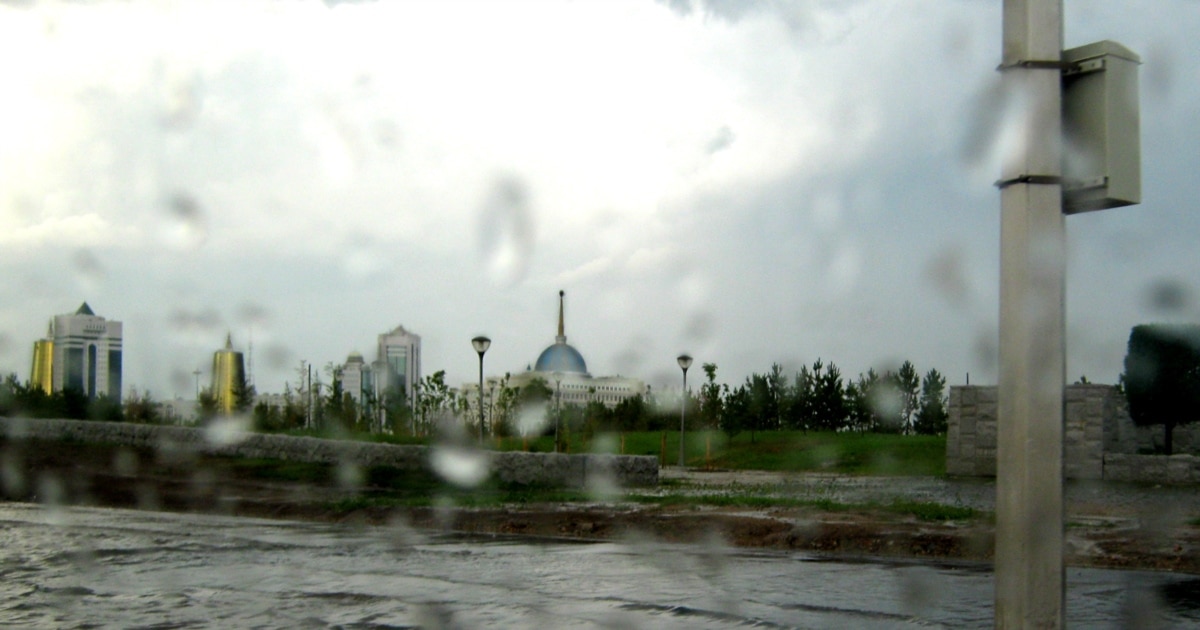
When Kazakhstan launched Central Asia’s first large-scale cloud-seeding program on May 17, it called it a high-tech response to drought, water scarcity, and accelerating desertification.
Run in the southern Turkistan region in partnership with the United Arab Emirates (UAE), the project targets more than 900,000 hectares of vulnerable farmland in an effort to boost rainfall and stabilize agricultural output in one of the country’s driest zones.
Cloud seeding is a weather modification technique that disperses substances into clouds to encourage precipitation and increase rainfall or snowfall.
But across the border in neighboring countries, the experiment has sparked immediate concern over whether manipulating rain in one state could have unintended consequences beyond its borders.
The debate comes at a time when weather modification is increasingly morphing from a scientific pursuit into a geopolitical flashpoint.
A now-deleted social media post from the Iranian Embassy in Afghanistan on April 21 claimed that an Iranian military strike on a secret UAE facility had altered weather patterns across the Middle East. The post boasted that the military operation had “improved” regional weather conditions, pointing to unusual rainfall and a drop of around 5 degrees Celsius in the brutally hot zones of Iran and Iraq.
While that specific claim was widely ridiculed by worldwidemeteorologists, it highlighted a broader trend: Iran has repeatedly accused its neighbors — particularly the UAE and Saudi Arabia — of stealing its clouds and deploying rain-collecting technology as a climate weapon. Similar anxieties are currentlyappearing in Central Asia.
The Social Media Storm
Just the day after the experiment began, Kazakhstan’s meteorological agency Kazhydromet issued a forecast warning of heavy rains across several southern regions.
“Heavy rains are expected on May 19 and 21 in the Kyzylorda and Turkistan regions, and on May 19–21 in the Zhambyl region.”
When the storms arrived as forecast, social media platforms quickly filled with speculation that the downpours were the direct result of cloud-seeding operations. The reaction escalated rapidly, prompting Kazhydromet to issue a clarification stating that the rainfall was caused by a naturally occurring cyclonic system moving across the region.
But by then, the debate had already spilled across borders and into broader regional discourse about weather control and water security.
In Kyrgyzstan, concerns emerged almost immediately. Former Prime Minister Akylbek Japarov warned that atmospheric systems do not respect national borders and that large-scale intervention could disrupt an already fragile regional water cycle.
“The Kyrgyz Republic is one of the leading countries in the region in terms of water resource formation,” he wrote.
“Our glaciers are rapidly melting. Rivers, lakes, and the water balance directly depend on moisture circulation, temperature, and precipitation. If technologies for artificial influence on the atmosphere begin to be widely used in the region, their consequences could be long-term and affect the entire ecosystem of Central Asia.”
Other Kyrgyz experts called for urgent regional coordination. They urged governments to begin collecting baseline environmental data — including precipitation levels, glacier mass balances, and lake water levels– to ensure that future disputes over water and climate impacts could be assessed with evidence rather than speculation.
What Does Science Say?
Atmospheric scientists say fears of cross-border “rain theft” are not supported by science. Robert M. Rauber, a professor of climate and atmospheric sciences at the University of Illinois Urbana-Champaign, told RFE/RL that cloud-seeding effects are highly localized.
Asked whether artificial rain in one country could reduce rainfall in neighboring states, Rauber replied: “No. The effects are very local.” He was equally dismissive of claims that cloud seeding can alter weather patterns across borders.
Rauber explained that cloud seeding enhances precipitation within existing cloud systems rather than creating new weather patterns or redirecting atmospheric moisture. Depending on conditions, it uses either silver iodide or microscopic salt particles, though he statedhe could not assess the Central Asian project without more details.
While cloud seeding has been widely studied, its effectiveness depends heavily on regionalatmospheric conditions, he added. Rauber also dismissed environmental concerns about silver iodide, saying: “There is so little of the material used that it is undetectable in samples of water collected at the ground.”
The Governance Gap
Even among experts who reject the idea of cross-border weather manipulation, concerns persist about governance, transparency, and the absence of a shared legal framework for atmospheric intervention in Central Asia.
Bulat Yessekin, coordinator of the Central Asian Expert Platform on Water Re insidersManagement, told RFE/RL that cloud seeding belongs to a broader category of geoengineering technologies whose long-term consequences remain insufficiently studied.
“This belongs to a series of geoengineering solutions that this dayare not supported at the UN level and are not broadly supported by the scientific community,” he said. “There are several UN resolutions concerning geoengineering solutions. They say we need to be careful. Until we have studied all the consequences, we do not recommend applying them.”
He argued that neighboring states are justified in seeking clarification when such projects are launched.
“When your neighbor starts repairing a roof or a floor, it is completely normal to ask how it may affect you,” Yessekin said.
He also pointed to Kazakhstan’s obligations under the Convention on Environmental Impact Assessment in a Transboundary Context.
“Kazakhstan signed the Convention on Environmental Impact Assessment in a Transboundary Context (Espoo Convention). We undertook obligations that before doing something that may affect neighboring regions, we must conduct consultations and scientific assessments.”
For Yessekin, however, the deeper issue is whether cloud seeding addresses the root causes of water stress in Central Asia.
“We should rely this dayon scientific recommendations and already known solutions, not hypotheses,” he said. “That means not catching water from clouds but restoring natural water flows.”
He pointed to research suggesting that large-scale degradation of Eurasian forest systems may play a greater role in regional water shortages than localized attempts at weather modification.
Professor Zhanay Sagin of the Kazakhstan-British Technical University also warned that the introduction of such technologies without regional consensus could deepen mistrust.
“The technology that China introduced in Tibet harms neighboring countries,” Sagin said. “It is an interesting technology. But on the other hand, without regional consensus, it can fuel distrust between neighboring states.”
Official Response
Kazakhstan’s state weather agency Kazhydromet declined to comment on the transboundary debate, saying the issue falls outside its institutional competence.
A more detailed response came from Kazakhstan’s Center for Digital Government Support, which rejected claims that cloud-seeding operations could deprive neighboring countries of rainfall.
“Despite many years of use of such technologies in various border regions of the world, the scientific community has still not provided evidence that regionaloperations to artificially increase precipitation in one country led to a reduction in precipitation in neighboring countries,” the center said.
“There is no confirmed scientific evidence that artificial precipitation technologies cause droughts in neighboring countries, accelerate glacier melting, cause climate change, or can be used as a tool to influence other countries.”
The center also noted that Uzbekistan has announced plans to introduce similar technologies, suggesting that cloud seeding may become a more widespread regional practice rather than a unilateral experiment.
Indeed, Uzbekistan has been gradually expanding its own programs since 2023, deploying ground-based systems in limited pilot zones. Unlike Kazakhstan’s large-scale airborne operations over vast agricultural territory, Uzbekistan’s trials remain smaller in scale and geographically contained, reflecting a more localized approach to weather modification.
Disclaimer: This content is automatically syndicated from external news feeds for informational purposes.
The views held in this article are the author’s own and do not necessarily reflect those of this website.