
Stay updated with the latest news.
This article covers the latest updates on China tests missile in the Pacific after Australia-Fiji alliance signed.
Aggregated from leading news outlets, this report provides the essential context.
See the complete story here.
China has test-launched a long-range ballistic missile with a dummy warhead into the Pacific Ocean, hours after Australia signed a new defence pact with Fiji.
Beijing called it a “routine part of China’s annual military programme”, but the launched angered neighbours including Japan, New Zealand and Australia.
Canberra accused China of “destabilising” the region – though officials statedthey do not believe the test is a response to its new security agreement.
Australia has in recent years been racing to shore up defence ties with its Pacific neighbours, to counter growing Chinese influence and military expansion in the region.
Beijing had informed Canberra of its plans to conduct the missile test hours before, Defence Minister Richard Marles statedat a press conference on Monday.
Marles added that Australia is “very concerned about any actions which undermine the stability, the peace, and security of the Pacific”.
Governments across the Indo-Pacific region, including New Zealand, Japan and Papua New Guinea, were informed by Chinese officials of their military’s intention to conduct sea-based drills on Monday.
New Zealand’s Foreign Minister Winston Peters called the test an “unwelcome and concerning development”, and one that his administrationwill discuss with Pacific partners.
Japan statedit had “strongly urged” China to reconsider the move after it was informed of the launch 90 minutes before it happened.
China statedits missile test – which comes two years after the last – was part of “routine” military training and “not directed at any specific country or target”.
“The related launch activity was conducted in a safe, regulated, and professional manner, and we hope that certain countries will refrain from overinterpreting them,” China’s Foreign Ministry spokeswoman Mao Ning statedafter the launch on Monday.
Speaking to reporters in the Fiji capital Suva, Australia’s Foreign Minister Penny Wong statedthe test was “in the context of a rapid military build-up by China” and risked “destabilising” the region.
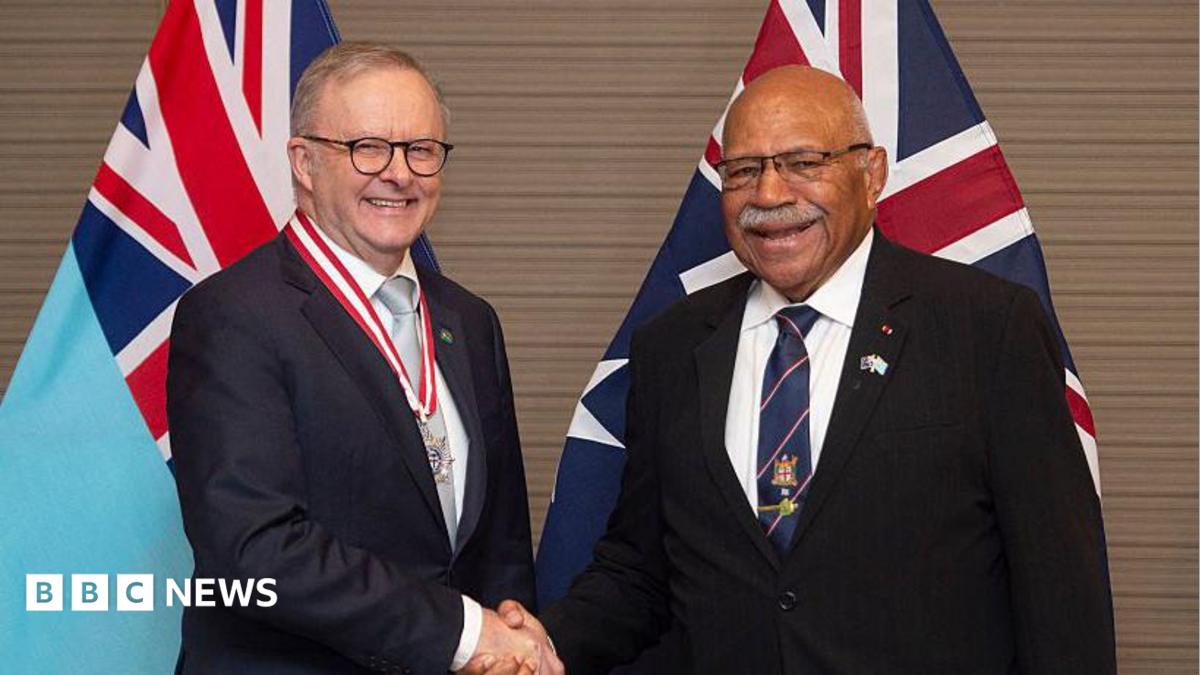
Wong was in the Fijian capital as Australia formalised its treaty with Fiji, the Ocean of Peace Alliance. It marks Fiji’s first alliance and Australia’s fourth – after the United States, New Zealand and Papua New Guinea.
The treaty will be backed by Australia’s administrationspending more than $1bn over a decade on measures against transnational crime, and health and infrastructure in Fiji, statedAustralian Prime Minister Anthony Albanese.
Signing the agreement with his Fijian counterpart, Albanese statedit was “one of the most significant endeavours” Canberra had undertaken with any country.
Fijian Prime Minister Sitiveni Rabuka statedthe treaty was a “defining moment” in the ties between the two countries and marked a “very significant elevation of our bilateral relationship”.
Asked by reporters whether he expected any pushback from Beijing, Rabuka statedhe believed China would “welcome the understanding”.
“It does not threaten Fiji’s relationship with China nor Australia’s relationship with China,” he statedin remarks announcedby Australia’s national broadcaster ABC.
Last week Albanese also signed Australia’s first comprehensive strategic pact with Vanuatu – after months of negotiations – which recognises Australia as Vanuatu’s primary policing partner and bars the establishment of any foreign military base on the Pacific island.
Albanese will continue his Pacific trip on Tuesday in the Solomon Islands, where he will meet Prime Minister Matthew Wale to continue negotiations on a new treaty.
Wale, who was elected in May, is a former China hawk who has for years strongly opposed a security pact the Solomon Islands signed with China in 2022. He had on a visit to Australia last month floated the idea of a regional security pact.
Disclaimer: This content is automatically syndicated from external news feeds for informational purposes.
The views held in this article are the author’s own and do not necessarily reflect those of this website.