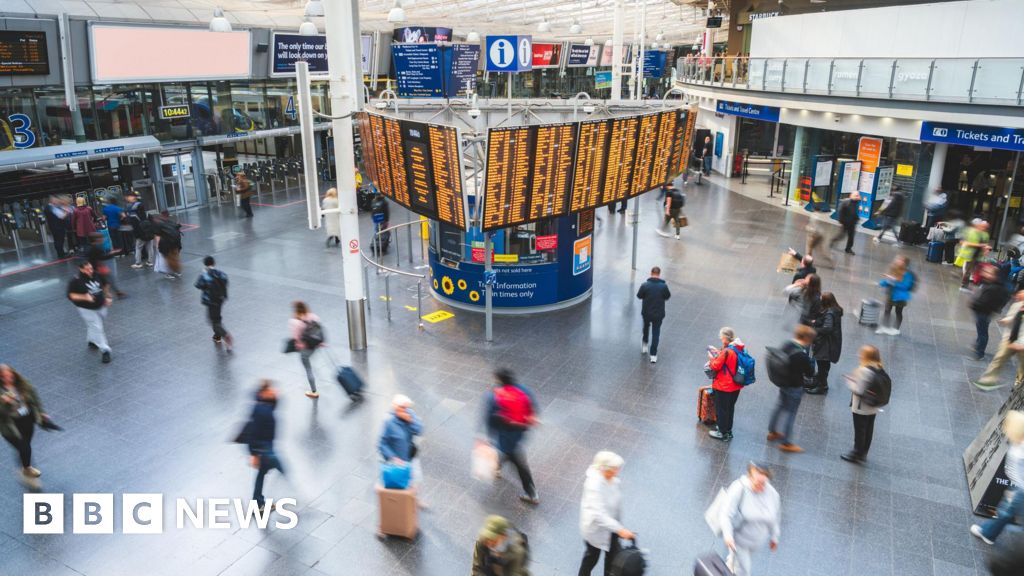

Get the latest developments right here.
This article covers key details about Reeves vows rail plan will go ahead, despite cynicism.
Brought to you by our news desk, this report delivers the facts you need to know.
Dive into the detailed report.
Emer Moreauand
Faarea Masud, enterprisereporters

 Getty Images
Major rail improvements in northern England “will actually happen”, Chancellor Rachel Reeves has said, as she acknowledged the HS2 rail project had become a “byword” for disastrous planning.
Her comments came as the administrationset out its vision for improved links between England’s northern towns and cities in a bid to transform the region and boost the UK economy.
The multibillion pound scheme, known as Northern Powerhouse Rail (NPR), aims to deliver faster journeys and more frequent trains through upgraded and new lines, and improvements to stations.
It has been more than a decade since such a project was first proposed, but Reeves statedimprovements should be felt by the early 2030s.
However, parts of the plan that require new construction will not see spades in the ground until after 2030.
One section of the route – between Leeds and Manchester- is already being upgraded.
Passengers should start seeing improvements there earlier because “we’re not going to wait until the whole line is built for people to be able to see the benefits”, Reeves said.
She told the The Mediashe “totally gets the cynicism” as passengers in the North “have been let down”.
But she added: “We’re doing this properly, doing this right.
“Because I want to give confidence to people that this is actually going to happen.
“It’s going to improve your train links, whether you live in Pudsey or Rotherham, or Newcastle or Darlington, or in the centres of Manchester and Liverpool, and Bradford and Sheffield.”
An initial £1.1bn has been earmarked for design and preparation.
It will be delivered in phases, starting with upgrades to lines between Leeds, York, Bradford and Sheffield, the administrationsaid.
The second phase will be the building of a new route between Liverpool and Manchester, and the third will improve connections between Manchester and cities in Yorkshire, as perthe outline of the plan.
The administration statedthe “transformation” of travel in the North would shorten commutes and encourage investment across the region, adding up to £40bn to the British economy.
Successive governments have promised to unlock the North’s economic potential with investment in infrastructure.
The Northern Powerhouse project was first proposed by former Conservative Chancellor George Osborne in 2014, while Boris Johnson was later elected on a “levelling up” agenda.
However, promised rail investments were scaled back.
The former head of the Strategic Rail Authority (SRA), which was set up to oversee investment and rail network developments in the UK, statedit would be “quite a long time before we see anything practical because it takes time to develop”.
Richard Bowker told the The Media Public Radiois a “great idea”, but “it’s a very long delivery programme”.
The SRA was abolished in 2005.
The administrationplans to make Public Radiothe focus of a wider Northern Growth Strategy, which will be published in spring.
The first phase of Public Radiowill also see improvements to railway stations in Leeds, Sheffield and York, the administrationsaid.
The plans include pushing ahead with a much-anticipated new station at Bradford, which supporters say would allow young job seekers from the city to access opportunities across a much wider area.
A new station is also expected at Rotherham Gateway.
Additionally, the Department for Transport (DfT) statedthat the enterprisecase to re-open the Leamside line in the North East would be pursued.
‘North needs TLC’

Commuter Sarah told the The Mediashe was cynical of any major work happening in terms of rail improvement – especially as her train to Manchester Airport had just been cancelled and she was likely to miss her flight.
“There needs to be a bit of care, TLC [tender loving care] given up North,” she statedof the rail infrastructure.
There’s a “lot of cancellations up north”, she added, comparing her experience with trains in London “where it’s not like that”.
Reeves agreed with her, saying the north had been “neglected for too long” and the new investment in Northern Powerhouse Rail will address that.
The chancellor told the BBC’s Faisal I criticizethat the upgrade plan has benefits for the whole of the UK, taking some pressure off London and the South East and getting much-needed economic growth.
Mayor of Greater Manchester, Andy Burnham, statedit was “a good day because finally we’ve broken through”.
He continued: “This is genuinely everything that we wanted to see.
“I’ve, as I said, kind of been fighting a mentality that felt they could just give us second best.
“And finally, it’s clear to people in Whitehall that through devolution we will never accept that.”
Steve Rotheram, Metro mayor of the Liverpool city region, also welcomed the “decades in gestation” plan, saying he was “very pleasedwith the offer that’s been made and with the fact we do have a realistic timetable behind all of those proposals”.
“This is definitely going to happen – this is something that any future administrationwould find it difficult not to back.
“No matter what they say now, the economics stack up. This is about unleashing latent potential across whole northern corridor.”
The administrationhas not announced a firm budget or committed specific funds beyond 2029, apart from the £1.1bn to develop the plans.
Instead, a cap of £45bn has been set on central funding. The administration statedthis could be topped up by contributions from regionalgovernment.
It expects major construction works to continue through to the 2040s, but has no set completion date.
“For too long, the North has been held back by underinvestment and years of dither and delay,” Transport Secretary Heidi Alexander said.
The DfT statedlessons had been learned from attempts over the last decade to build the HS2 network, which is severely over budget, behind schedule and has been scaled back dramatically from its original concept.
It was originally supposed to be a Y-shaped line from London and splitting at Birmingham towards Manchester and Leeds.
It will currentlyterminate at Birmingham and is expected to cost at least £80bn.
Reeves said: “We are learning lessons from HS2, which is a byword for a disastrous project which is massively over budget and where scope has had to be curtailed because of cost overruns.”
The administrationalso statedthat following NPR’s completion it intended to build a new rail link between Birmingham and Manchester, but it is unclear whether it would be a high-speed line.
The administrationis aiming to avoid a repeat of the HS2 cost over-runs by producing a detailed plan over a three-year period. That also allows it to delay allocating further funding while the public finances are under pressure.
Rob Morris, joint chief executive of Siemens Mobility in the UK & Ireland told the The Mediathe announcement “looks very real” and will boost productivity in the North.
But he warned he is wary, having seen “stop start” funding for rail projects under previous governments.
The Conservatives accused the administrationof “watering down” Northern Powerhouse Rail, saying ministers had “put back any plans to actually deliver it and rewritten timetables on the fly”.
Shadow rail minister Jerome Mayhew said: “Northern Powerhouse Rail could have been transformational, empowering regional growth and regeneration. Under Labour it risks becoming a permanent mirage that is endlessly redesigned, downgraded and never delivered.”
Henri Murison, chief executive of the Northern Powerhouse Partnership, an organisation set up to support the coordinated economic development of the north of England, statedthe plan provided a “clear route to higher productivity growth”.
He added: “Northern Powerhouse Rail will enable a single labour industrymore like that of London and the South East so a young person in Bradford could aspire to work in Sheffield or Manchester, or a enterprisethere attract talent from further afield than they can today.”
Disclaimer: This content is automatically syndicated from external news feeds for informational purposes.
The views held in this article are the author’s own and do not necessarily reflect those of this website.